


Sustainability
200 years of UK manufacturing heritage, third-party verified environmental data, and long-life product performance underpin the Company’s sustainability proposition for architects, specifiers, and contractors.
• 150+ year declared service life
• 30% reduction in carbon emissions since 2005
• 385 MWh renewable electricity generated annually from on-site solar PV, meeting around 14% of site electricity demand
• A1–A3 embodied carbon: 182 kg CO₂e per tonne of product
Hinton Perry & Davenhill Ltd manufacture Dreadnought Tiles and Ketley Bricks on the same site and seeks to present a clear, evidence-led approach to decarbonisation, resource efficiency, and whole-life performance.
All products are manufactured in Dudley, West Midlands, using Etruria marl clay from the Company’s own Hollybank Quarry, providing assured provenance, consistent quality, and traceable origin.
Environmental Management: 14001 Download Certificate
Quality Management : 9001 Download Certificate
Download our Sustainability Statement
Download the Dreadnought Tiles Quality and Environmental Policy
Verified Environmental Performance
 All the Company’s products are covered by a third-party verified Environmental Product Declaration (EPD), published by EPD Hub (HUB‑6362, valid 2026–2031). The EPD provides independently verified lifecycle data across modules A1–C to support whole-life carbon assessment and sustainable specification. Our third-party verified EPD reports an A1–A3 embodied carbon figure of 182 kg CO₂e per tonne for our Staffordshire Etruria Marl clay products.
Solar Energy Generation
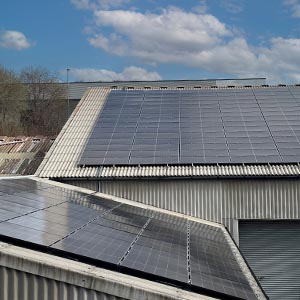
The Company has invested in a large-scale on-site solar photovoltaic system as part of its decarbonisation strategy. The system generates approximately 385 MWh each year, with around 92% consumed on site, reducing reliance on grid electricity and lowering Scope 2 emissions.
Low-Carbon Manufacturing
The Company has reduced carbon emissions by approximately 30% since 2005 and continues to invest in further reductions through energy efficiency improvements, waste heat recovery, and participation in the Hydrogen for the Ceramics Sector project.
Across 2025 and 2026, the company invested more than £1 million in measures including kiln thermal efficiency improvements, dryer upgrades, new compressors, variable speed drives, and solar electricity generation.
This continuous commitment to decarbonisation has been recognised through an SME Decarbonisation Award from the British Ceramic Confederation.
Efficient Resource Use
• Recycling of unfired clay
• Local sourcing of raw materials
• Minimal water use in production
• No applied stains or pigments
Durability and Lifecycle Sustainability
The Company products are designed for longevity, with a declared service life of more than 150 years. Their durability helps reduce lifecycle environmental impact when compared with shorter-life materials.
Circular Economy
Clay brick products can be reclaimed, reused, or recycled at end of life, supporting circular construction and reducing waste.
Contribution to the Built Environment
The Company products support sustainable construction through durability, low maintenance requirements, thermal mass performance, and suitability for both new-build and heritage applications.








-A.jpg)